Five More Case Histories Refreshed
GBA Publications Committee
Learn from others. Don’t repeat the mistakes of the past! 
GBA Case Histories are being used by our members for loss prevention discussions in support of professional development and mentoring. That is why GBA case histories are so valuable, and why GBA is updating them all, while adding new ones, too. Five more Case Histories have been re-issued.
Case History #71 (download)
A geotechnical engineer submitted its flawless subsurface exploration report which referenced an ASTM standard on soil classification. When a cost overrun occurred on the project, because a buried foundation was discovered, the assistant state’s attorney general handling the case read the report. He interpreted ASTM “references” in the standard to mean “incorporated by reference,” and so proceeded to read each of the 15 referenced standards. One of the 15 feasibly could have been interpreted to have placed a burden of performance on the geotechnical engineer which, if fulfilled, might have prevented the problem. Although the lawyer’s interpretation was unrealistic, it was realistic enough to stand up in court, the geotechnical engineer assumed, and so settled.
Case History #72 (download)
A Member Firm was negligent, its client said, because the firm had failed to follow the precepts of a draft version of the nascent GBA standard on performing a Phase I environmental site assessment. At trial, the defendant’s expert cited Recommended Practices for Design Professionals Engaged as Experts in the Resolution of  Construction Industry Disputes and pointed out that the plaintiff’s expert had not established the standard
of care using methods discussed in Recommended Practices…, and therefore did not have a case. The judge agreed.
Case History #73 (download)
The client’s “hired-gun” expert criticized the Member Firm’s project manager of negligence as the expert for the plaintiff-contractor because, in providing her opinions, she failed to recognize the importance of strict code compliance. He, on the other hand,  “had based his opinions on his vast experience; inquiry into the methods used by others was unnecessary.” the Member Firm’s expert explained that in developing her opinion, she had followed recommendations for establishing the standard of care, as set forth in Recommended Practices for Design Professionals Engaged as Experts in the Resolution of Construction Industry Disputes. The client’s expert admitted he had not. The judge, swayed by the thoroughness and professionalism of the Member Firm’s expert, upheld the contractor’s claim.
Case History #74 (download)
The GBA-Member Firm, serving as a design/builder, retained a remediation contractor via an agreement that required the contractor to have written approval before pursuing a change. The engineer’s fill-in project manager wasn’t aware of the contract’s requirements, nor was the contractor’s fill-in manager. A major change was  needed to complete the work and it was performed. When the client refused to pay the engineer, the engineer refused to pay the contractor, because a written change was not obtained. The engineer learned that sometimes the clearest, most explicit language might not be binding.
Case History #75 (download)
A state OSHA inspector issued a number of citations to a Member Firm whose personnel were performing a caisson inspection. Most of the citations were for various aspects of the work that simply had to be done if caissons were to be inspected. The OSHA personnel’s attitude was that caisson inspection was inherently dangerous and should not be done. The Member Firm learned the importance of dealing with OSHA via an attorney who understands the issues.
GBA Case Histories are FREE to all Members.
Access all GBA Case Histories: HERE
 German Mom. They came to the U.S. after World War II to make a new life and found each other in the land of opportunity. Our extended family was eleven with 5 from Europe and 6 born in the U.S. As a mixed heritage family, we did not have rich traditions from Europe or the U.S. but developed our own over time.
 I followed my father’s footsteps and began studying electrical engineering at the University of Pittsburgh. Lissajous figures were not exciting to me and frankly, made no sense. My father’s warnings about becoming a “ditch digger” echoed in my head and I changed course to civil engineering like my roommate. It was through civil engineering that I found my true calling as a geotechnical engineer.
 I could not have predicted my career path when I changed courses from electrical engineering to geotechnical engineering. I never imagined that I’d have the chance to do the things I’ve done, develop relationships with all the people I’ve met, and regularly been amazed by our vast world. I’m so lucky that I have been accompanied on this journey with my wonderful wife of 35 years, Lisa, and my amazing, accomplished daughters Amy and Holly. And now I am a Grandpa!
 GBA has updated one of its most frequently, all-time best-selling resource – Important Information about This Geotechnical-Engineering Report. Some of the language and sections have been modified and updated,
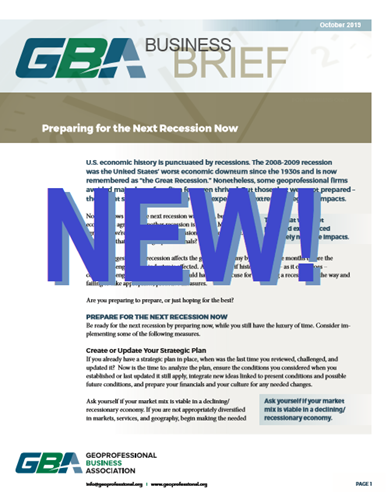 that another recession is certain. Most also agree that we’re getting closer to the next recession. What can geoprofessionals do now to prepare?
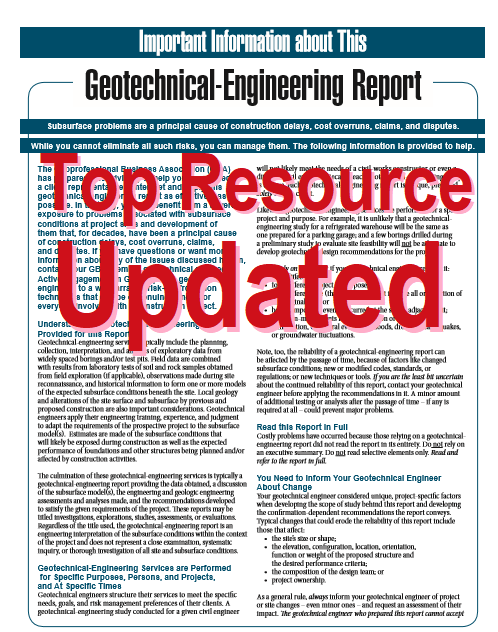 – Important Information about This Geotechnical-Engineering Report. Some of the language and sections have been modified and updated, including a new section about understanding the geotechnical engineering services.
 our website for “on-demand” viewing.
 are being used by our members for loss prevention discussions in support of professional development and mentoring. That is why GBA case histories are so valuable, and why GBA is updating them all, while adding new ones, too.
 and failure occurred. Although the GBA member was relatively blameless, it had agreed to an unwise indemnity in its contract and faced the potential of litigation that would likely cost it more than $1 million before reaching a settlement.
 basketball games in our driveway and football in our neighbor’s side yard, kept me, my three brothers, and the neighborhood kids busy and out of trouble. Later we started organized sports, first Little League then Junior High and High School. Most of the folks in our town are HUGE Dallas Cowboys fans even going so far as to schedule the Sunday morning services to allow time for the congregation (which included our family) to make it home in time for a noon kickoff.
 After graduating from high school with my other 32 classmates, I was fortunate to get a full-time summer job with the nearby Area Office of the Texas Department of Transportation (TxDOT). Until then, I had primarily mowed yards and worked part time at local grocery stores. The TxDOT job was my first exposure to civil engineering and surveying. For the next 4 summers, I had a great time learning about surveying as a member of the field party, preparation of drawings for highways, running tests in a hot mix lab at a remote batch plant and working as an inspector at a ready mixed concrete plant. To this day, I fall back on what I learned and enjoy some of the relationships that I formed.
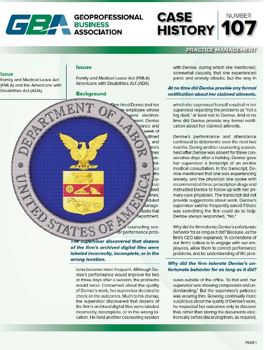 a member firm is faced with alleged violations of the Family and Medical Leave Act (FMLA) and the Americans with Disabilities Act (ATDA). This Case History emphasized Project Managers must be trained in basic human resources (HR) issues and the importance of documentation when dealing with employee performance management.
 week about his upcoming keynote presentation at GBA’s 2019 Fall Conference. Mr. Samuels is the Chairman Emeritus of
 superintendent. I liked to play golf and I was working on the grounds crew of the local course, so becoming the course superintendent seemed logical. I then learned that a golf course maintenance career meant that every weekend required my services from dawn to dusk. I’m not afraid of long hours, but I wanted to have weekends available for something other than work.