GBA Releases Five More Case Histories: 56-60
GBA Publications Committee
 Learn from others. Don’t repeat the mistakes of the past! GBA Case Histories are being used by our members for loss prevention discussions in support of professional development and mentoring. That is why GBA case histories are so valuable, and why GBA is updating them all, while adding new ones, too. We are more than halfway done as five more case histories have been re-issued.
CASE HISTORY NO. 56 (download)
After a field representative failed to note that organic material had been buried instead of taken off site, the Member Firm that employed him submitted a form noting that grading had proceeded according to plans. The gradin g subcontractor relied on an outdated site map, which resulted in unsuitable organic fill beneath 100 of 250 housing lots.
CASE HISTORY NO. 57 (download)
A Member Firm environmental consultant agreed to indemnify landowners whose wells were to be tested, because EPA said it would indemnify the consultant. The EPA’s agreement was not in writing, however. When a problem developed, EPA refused to help resulting in a $60,000 settlement.
CASE HISTORY NO. 58 (download)
Precautions that were needed to help ensure success of an innovative approach were explained orally to a client, but not documented. The project failed. Despite overwhelming evidence that the client and earthwork constructor failed to comply with specifications, the client blamed the Member Firm resulting in a $300,000 settlement by the Member Firm.
CASE HISTORY NO. 59 (download)
Project risk is inversely proportional to project size, complexity and fee. The GBA-Member Firm conducted a Phase I ESA for a small area of a shopping center site, optioned to another party. The prospective purchaser discovered a tiny amount of contamination in an area the consultant was not authorized to study, then backed out of the deal, forfeiting its deposit. The prospective purchaser sued the Member Firm.
CASE HISTORY NO. 60 (download)
What started out as a favor for a potentially big client, turned into a nightmare. To meet a short deadline, a GBA member located an underground tank on its own, obviating contract protection. About 50 gallons of oil leaked when an exploratory boring impacted the integrity of the tank resulting in more than a year of conflict and negotiation.
GBA Case Histories are FREE to all Members. Access all GBA’s Case Histories HERE
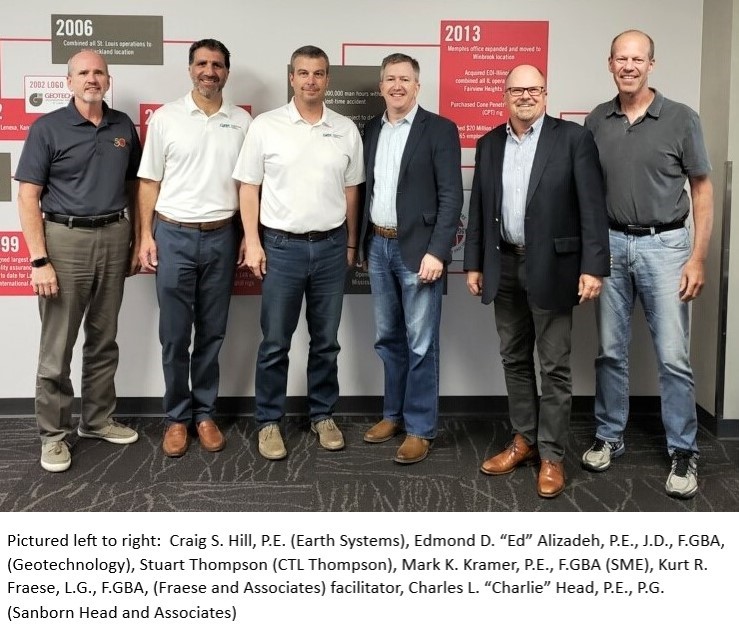 discussion platform where small groups of Member-Firm executive leaders meet to candidly address their most pressing issues and draw on the experience of others who’ve faced similar situations. The first Peer Group held their second meeting at Geotechnology’s office on April 25-26 in St. Louis.
 Those that attended GBA’s 2019 Spring Conference in Wailea, Hawaii agreed that the presentations were educational, entertaining, and inspiring. Now you can watch, listen to, and learn from these speakers, too, on your own schedule, and without leaving your office.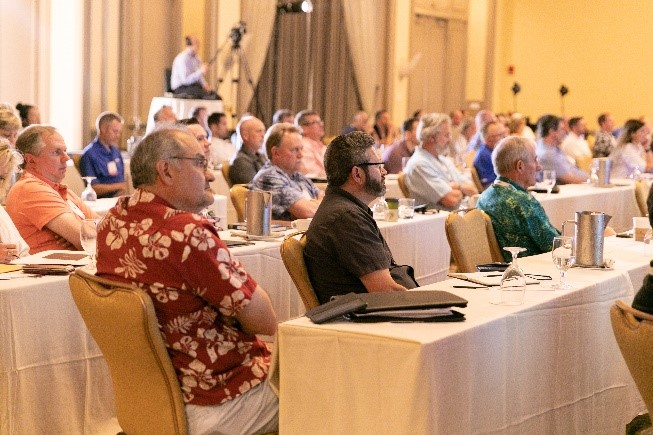
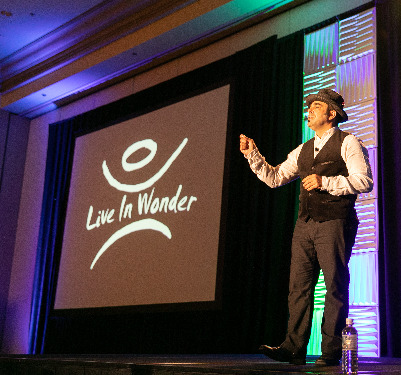 Eric Saperston has spent the last 25 years cold calling and taking the most powerful people in the world out for a cup of coffee (all from a VW bus with his dog tagging along). Eric’s wisdom, humor, and inspiration will wow you while you learn the common traits, motivating factors, and guiding principles he discovered in these people, and how they can enable everyday people to produce extraordinary results.
 Dinner, exceptional member firms and volunteer leaders were recognized for their engagement, support, and volunteer efforts. In total, over 40 individuals were recognized and four Member Firms.
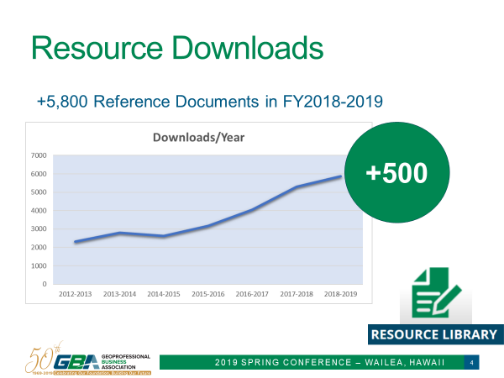 association the opportunity to prepare for the future by replenishing in our reserve fund. Our growing financial strength is underscored by the positive view our members have of the current economy. An instant poll of the participants on the topic of business climate described the overall feeling of members as “optimistic” and “busy,” with 60 percent anticipating increases in revenue over the next year. Members expressed that their biggest 2019 challenge was the recruiting and retention of staff.
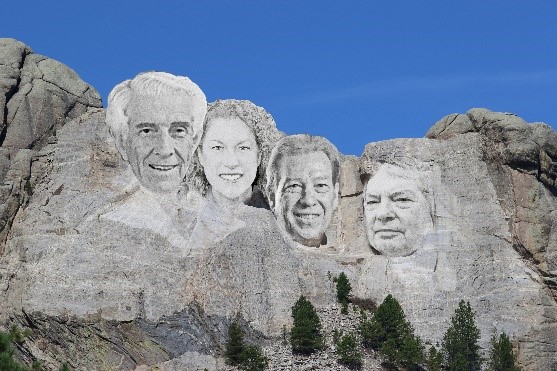 In a panel discussion, Past President’s and GBA Fellows Laura Reinbold (2016-2017), Gerry Salontai (2004-2005), Rich Millet (1997-1998) and Ed Wilson (1989-1990) reflected on GBA leadership accomplishments and the way we get things done. Highlights included descriptions of the origin of limitation of liability, peer review and alternative dispute resolution. It was noted that all of these powerful tools were individual ideas that were brought to the organization and perfected by committees. GBA has a great tradition of honoring individual thought and making the best ideas actionable. We were reminded that no other professional association has as much collegiality as GBA because at our core we have demonstrated decades of trust and delivering value.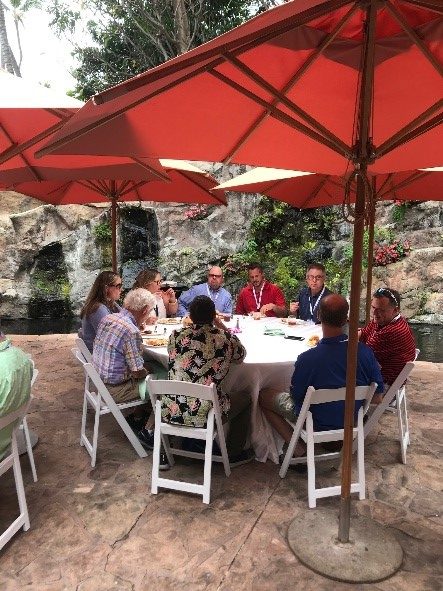
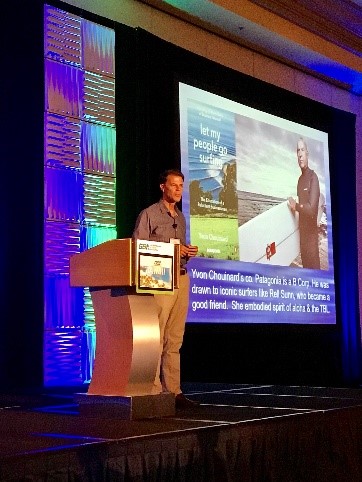 Who says geoprofessionals aren’t funny? We were taught powerful communications techniques through the lessons of improvisational comedy by Nancy Watt, a Second City Conservatory Graduate. The session included audience participation in demonstrating that anyone can learn these techniques of effective communication and collaboration. It all starts with speaking and listening from a “Yes, and…” rather than a “Yes, but…” perspective. It also proved we have some real comedians among our members.
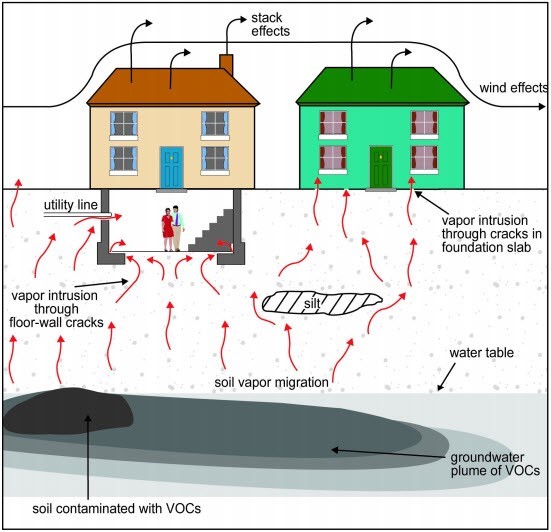
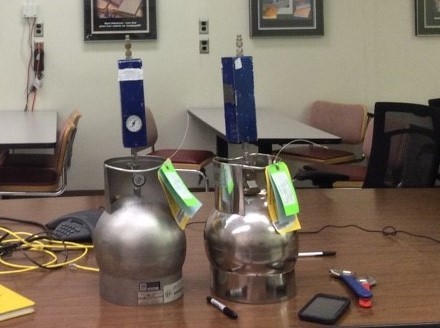 to many variables, including environmental condition (e.g. temperature, barometric pressure, wind, and precipitation), and building conditions (e.g., heating and cooling system operations, door and window positions). Another complicating factor of VI assessments is understanding whether indoor air contamination is a result background sources such as stored chemicals in the building, or even building materials. Thus, it is difficult to collect a single sample and draw conclusions about VI risk.
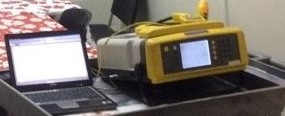 potential background vapor concerns in discrete areas of the building without the added costs of a mobile laboratory.
 potential as consultants and business leaders. Our goal is to provide those future leaders with tools to accelerate their growth and unleash their potential through education, networking, and collaboration. While networking with other similar emerging leaders, each emerging leader will expand their knowledge through GBA’s unique business-education resources associated with risk management and business performance optimization.
 GBA President-Elect Arthur G. “Art” Hoffmann, P.E., D.GE (Gannett Fleming, Inc.) will become President and Chair of the GBA Board of Directors.
 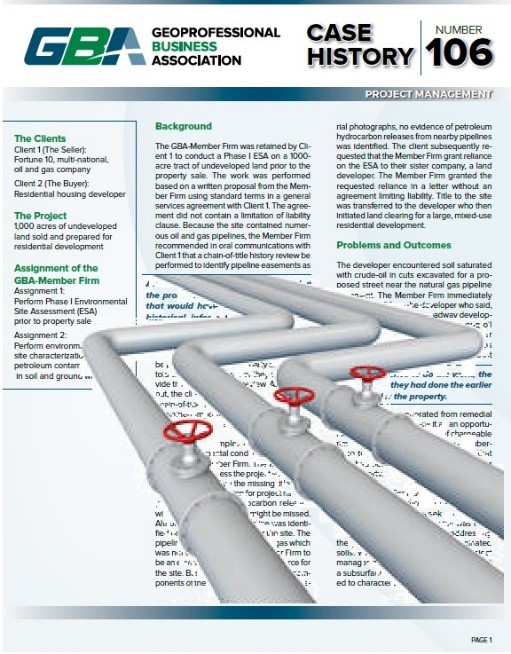 and instead told the Member Firm that they would provide title information for review.
 has a tradition of collaborating on issues that impact the geoprofessions through GBA Case Histories. GBA Case Histories provide unprecedented real-world learning examples related to project and business management. Learn where others went wrong, how they handled their problems, and how you can learn from their experiences to avoid the same problems in the future.
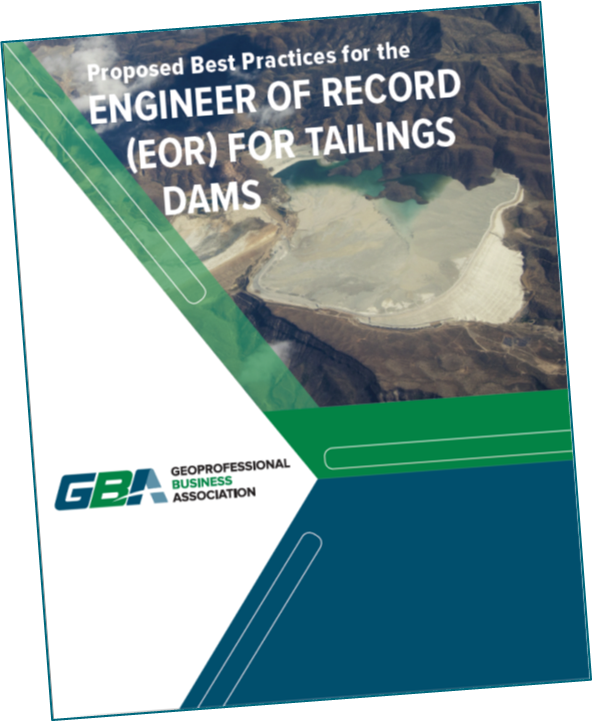 In February 2019, the United States Society on Dams (USSD) announced their endorsement of GBA’s recently published Proposed Best practices for the Engineer of Record (EOR) for Tailings Dams.
 the mistakes of the past! GBA Case Histories are being used by our members for loss prevention discussions in support of professional development and mentoring.That is why GBA case histories are so valuable, and why GBA is updating them all, while adding new ones, too. We are halfway there as five more case histories have been re-issued.
 Although the Member Firm’s CEO got personally involved and “saved the day,” serious problems arose. The firm had to pay $350,000 to extricate itself, because a judge or jury probably would not have understood the technical intricacies that proved the member was blameless.
 itself from a football stadium rebuilding project. Problems arose when its original recommendations were not followed. The firm was unaware of certain changes that were made, but casual language in a report made that position difficult to defend.